Hello everyone! Today I’m starting a new series in this blog about the basics of Ashkenazi research with a new entry in it every Friday. The first post we shall start with talking about Hebrew and Yiddish names, and common anglicizations of them. So let’s get started!
First off let’s start with what exactly is a Hebrew name? A Hebrew name is a name in Hebrew used in certain religious contexts such as calling someone to the Torah, praying to recover from sickness (see my previous post about Kvitlekh for an example), or the most common example in genealogy graves! (which I’m going to be covering in the next post in this series)
A Hebrew name is important in genealogy because not only does it fill out the life of your ancestors a bit more, it also usually mentions their father’s (and sometimes mother’s) name!
Now for Yiddish names, back in the old country Jews commonly used Yiddish day to day name or the more “official” name their “kinnui”/secular name. Now these kinnui while not all the time, but the majority of the time had a Hebrew counterpart that most people with that kinnui would have as their Hebrew name.
For an example let’s use the person mentioned in my previous blog post Rabbi Meir Feivel of modern day Golub-Dobrzyn. He had the kinnui of Feivel whose common Hebrew counterpart is Shraga, and what do you know when I found a record with his Hebrew name is it indeed Meir Shraga.

Now like I said while it is very common for a Yiddish name to have a Hebrew counterpart, not everybody follows that rule, and example I can give is I was recently researching someone with the Yiddish name Zalman which is the common kinnui for Shlomo, but his Hebrew name was instead Shmuel, whose common kinnui is just Shmuel not Zalman.
Anglicization
While there are no times where you can see an anglicized name and say something like “Oh Max’s Hebrew name must be Moshe!” there are still several noticeable trends which I shall list several common ones below
- Moshe – Max/Morris
- Chaim – Charles
- Shmuel – Samuel
- Yitzhak – Isaac
- Avram – Abraham
If you wish to read more about anglicizations I recommend this wonderful article by by Jason Greenburg that is free to view and download that goes quite a bit more in depth.
Example of how Hebrew names can help
Let me show an example of how a Hebrew name helped me break through a brickwall. My second-great grandfather, his mother, and siblings immigrated to the US together, and in the passenger lists (Another future post in this series is going to be about those) they were coming to meet “Abraham Bajewski” (whose real surname was Bayefsky which was anglicized into Bafsky) who is my 3rd great-grandfather, and a “Uncle” “Louis Kessler”.
Through various records I managed to tracked who I thought was him a Love Kaslow one of the founders of a Jewish agriculture colony of Garsake, North Dakota. He lived a very fascinating life, but I wont get in to that today. Anyways I found out that his wife Rebecca had the maiden name of “Beafsky” according to some indexes, I then found her grave which gave her the Hebrew name of “Feiga bat Shmuel HaLevi” while Abraham’s grave gives him the name of “Avraham ben Shmuel HaLevi“.
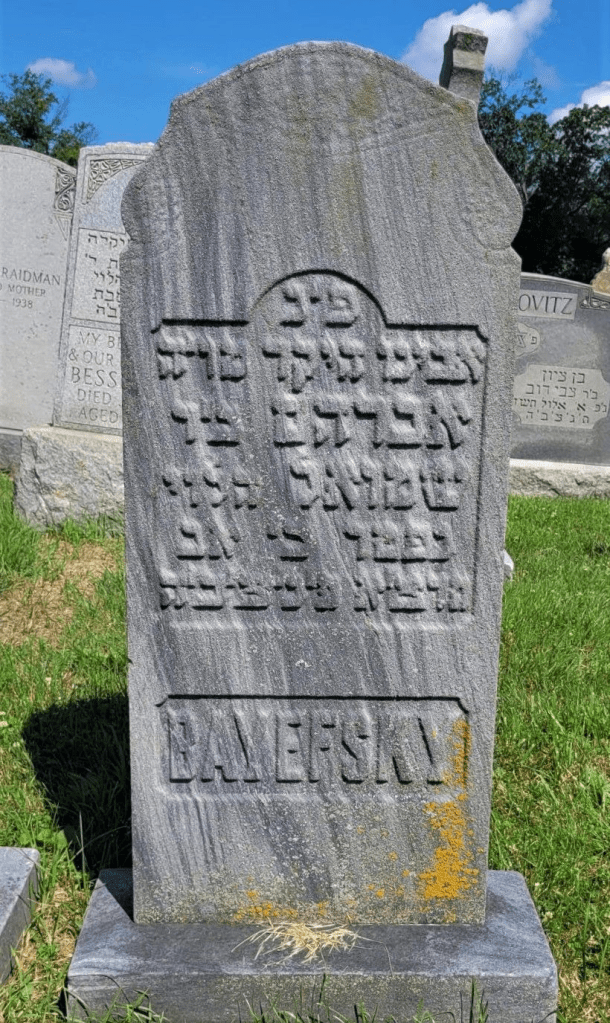
Sadly with the records back in Europe that would confirm or deny existing to my knowledge, and not being able to find Rebecca’s death certificate I have not been able to fully confirm whether her and Abraham are siblings or not, though I do find it likely they in fact are.
Next Week
Thanks for reading this post! The next part in this series is about reading Hebrew on graves and can be found here


Leave a comment